

 |
 |
|
Innovation, Language, and Organizations
|
||
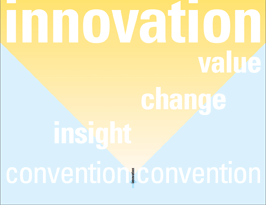
Studying past innovations may be interesting but likely not prescriptive, because the specifics that create the context for innovation will never be repeated. A rigorous study of innovators (and their precursors, inventors) may be useful, because an understanding of human characteristics may guide the development of future innovations. More so, understanding the relationship of language to innovation is key, because language determines what cannot be talked about, and therefore what cannot be achieved. In this context, Paul Pangaro answers questions in two broad areas: What is “Innovation” and how do we get it? The term is ubiquitous, its meaning diluted, and means to achieve it are muddled. Pangaro argues that innovation is an insight that enables change which creates value. Articulation and demonstration of the insight are prerequisites to adoption—to the realizing of potential contained in the insight. Obsession is required as a property of both the "inventor" (who originates the insight, through persistence to solve a problem) and the "innovator" (who foresees the value before it is realized, and persists in bringing about change). A detailed model of innovation is offered as a means to delineate phases and requirements, and to reveal how innovation can (and cannot) be fostered. What is “Organizational Language” and what are its properties? The language of an organization is the means by which participants create models of their environment, frame the problems they hope to solve, and explain possible means for solving them. As such, Pangaro argues, language becomes the basis both by which an organization succeeds under current conditions, and is unable to see those conditions changing. Pangaro shows how language is both this blessing and curse, and outlines a solution against being trapped in present-day language. He suggests a means for organizations to judge an appropriate trade-off for allocating resources for developing new language versus implementing plans based on the current language. |
||
| Paul Pangaro is the Chief Technology Officer of CyberneticLifestyles.com in New York City, where he consults at the intersection of product strategy, marketing, and conversational dynamics. He is recognized as an authority in conversation theory, which he has been applying to human-machine interaction and personal & organizational learning for 25 years. He was CTO of several startups, including Idealab's Snap.com, and was senior director and distinguished market strategist at Sun Microsystems. Paul has taught a course at Stanford University since 2002 on the role of cybernetic models in the design of products, services, and teams. He holds a PhD from Brunel University (UK) in cybernetics and a BSci in Humanities/ Computer Science from MIT. | ||
Related Links
Presentation Materials for this talk [7MB PDF] Interview on the subject of innovation, from the website of Instituto ITAÚ Cultural [original Portuguese version] A Model of Innovation in the form of a concept map, written by Hugh Dubberly, Nathan Felde, and Paul Pangaro Notes on the Role of Leadership and Language in Regenerating Organizations, a short publication on the relationship of language to organizations |